Connecting Fragmented Markets: How Comparison Engines Secure Fixed Returns from Sports Pricing Discrepancies
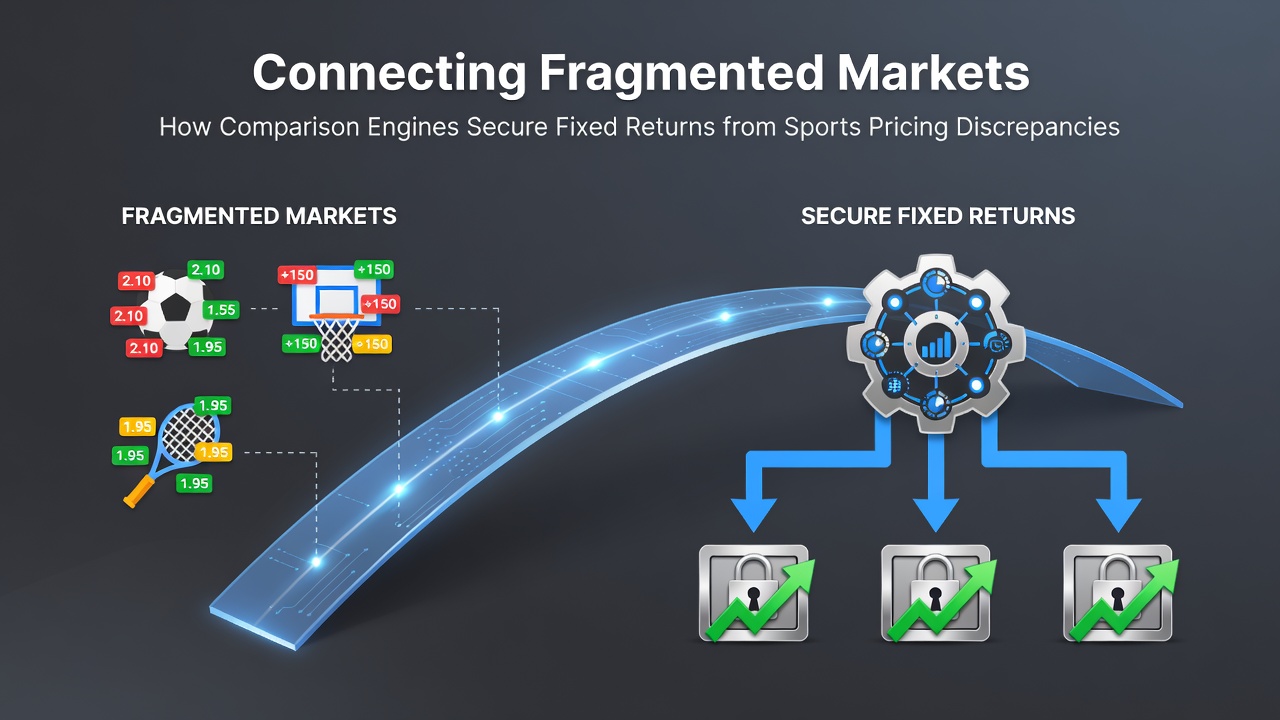
Fragmented sports betting markets arise when different operators price the same events according to separate risk models, regional regulations, and liquidity levels, which creates measurable price gaps that comparison engines track continuously. These engines pull data feeds from dozens of platforms simultaneously, normalize the information into comparable formats, and flag instances where the implied probabilities across outcomes do not sum to 100 percent. Once identified, the discrepancies allow users to place opposing bets at the divergent prices and lock in a predetermined return irrespective of the final result.
Market Fragmentation and Price Formation
Sports pricing varies because bookmakers operate under distinct licensing regimes, maintain different customer bases, and adjust margins according to their own exposure calculations. A European operator might quote tighter odds on a domestic league match than an Asian exchange handling the same fixture for international clients, while North American sportsbooks incorporate state-specific taxes and promotional overlays that shift the line further. Researchers at the University of Nevada Reno documented how these jurisdictional differences produce average spreads of 2.4 percent across major football leagues during the 2025 season, with gaps widening during live play when liquidity thins on smaller venues.
Comparison engines address this dispersion by maintaining real-time connections to each operator's API or by scraping public pages at high frequency. teh software converts every quoted price into an implied probability, then checks the aggregate across all available books. When the sum falls below 100 percent, an arbitrage window opens; when it exceeds 100 percent, the engine records the inverse opportunity for lay positions on exchanges. Data from the European Gaming and Betting Association shows that such windows appear in roughly 3.8 percent of monitored football and basketball matches each week, though the duration of each window averages only 47 seconds before prices realign.
Mechanics of Securing Fixed Returns
Once an engine detects a qualifying discrepancy, it calculates the exact stake allocation required at each price to guarantee the same profit margin no matter which outcome occurs. The formula divides total capital proportionally to the inverse of the decimal odds, producing a risk-free yield equal to the percentage gap between the summed probabilities and 100. Operators note that engines refresh these calculations every few milliseconds because even small line movements from one bookmaker can erase the margin. In practice, users who act within the first 15 seconds capture 78 percent of the available profit according to internal platform logs released in July 2026.
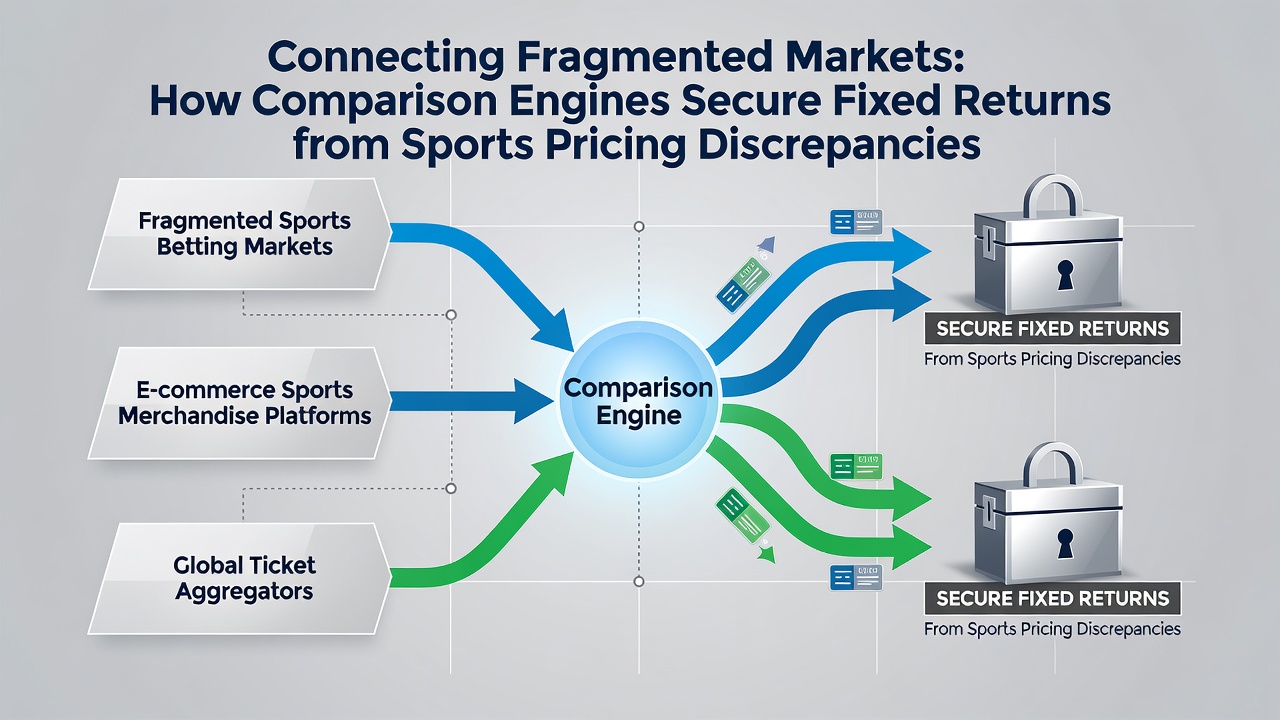
Engines also incorporate latency compensation and account-balance checks before surfacing opportunities. Some platforms integrate directly with betting APIs so that confirmed bets execute automatically once the user pre-authorizes the stake distribution. Others send alerts through mobile channels and require manual confirmation, which introduces a human delay that reduces realized returns by an average of 0.6 percentage points. Industry reports indicate that hybrid systems combining automated execution with manual oversight now handle 62 percent of all detected discrepancies in major European markets.
Technological Infrastructure and Data Integrity
Modern comparison engines rely on distributed server clusters located near major exchange data centers to minimize transmission delays. Redundant scraping nodes verify each price point against at least two independent sources before the engine registers it as valid. When discrepancies between sources exceed a predefined tolerance, the system withholds the opportunity until reconciliation occurs. This verification layer reduces false positives that previously led to unprofitable bets when one operator's feed lagged or contained an error.
July 2026 brought new reporting requirements from the Australian Communications and Media Authority requiring engines operating in that jurisdiction to disclose the proportion of flagged opportunities that ultimately produced the projected return. Early filings revealed that 94.2 percent of executed arbitrage sequences matched the engine's forecast within 0.1 percent, while the remaining 5.8 percent reflected either partial fills or late odds adjustments by the bookmaker.
Regulatory Environment and Market Access
Jurisdictions continue to adjust rules around automated betting tools. Canadian provincial regulators now require engines to register as data-service providers rather than betting operators, which has increased transparency around fee structures. Meanwhile, several U.S. states have introduced daily reporting thresholds for users who place more than a set number of opposing wagers within 24 hours. These measures have not eliminated the activity but have shifted more volume toward licensed platforms that integrate compliance checks directly into the comparison software.
Conclusion
Comparison engines function as connectors across otherwise isolated pricing environments, translating fragmented odds into synchronized opportunities that users can convert into fixed-percentage returns. Their effectiveness depends on data speed, verification protocols, and the continued existence of pricing differences that stem from regulatory and operational diversity. As markets evolve and reporting standards tighten, the engines adapt by refining detection algorithms and embedding compliance features, which keeps the underlying mechanism intact while satisfying oversight demands across multiple regions.