Global Rugby Union Odds: How Margin Strategies Combine Value Scanning and Arbitrage Across Hemispheres

Bookmakers set margins on rugby union contests by factoring in team form, player availability, weather conditions and historical head-to-head results, yet those margins often diverge when northern-hemisphere and southern-hemisphere books price the same fixture. Value scanners detect lines where implied probability sits below a bettor’s estimated true probability while arbitrage calculators flag instances in which opposing wagers at two or more books guarantee a fixed return regardless of outcome. When the two systems operate in tandem, margin plays emerge that capitalise on those pricing gaps without requiring the user to predict match winners.
How Margin Plays Differ from Standard Rugby Bets
Margin plays focus on the numerical difference between teams rather than simple win-loss outcomes, so scanners first isolate markets such as handicap lines, try-scoring margins and total points bands. Researchers have observed that southern-hemisphere books, particularly those licensed in Australia and South Africa, frequently shade totals markets more aggressively during Super Rugby Pacific rounds, whereas European operators adjust handicap thresholds more sharply when Premiership or United Rugby Championship fixtures cross time zones. The resulting discrepancies create short windows in which a scanner can highlight an overpriced margin at one book and an underpriced counterpart at another.
Scanner and Arbitrage Tool Integration Mechanics
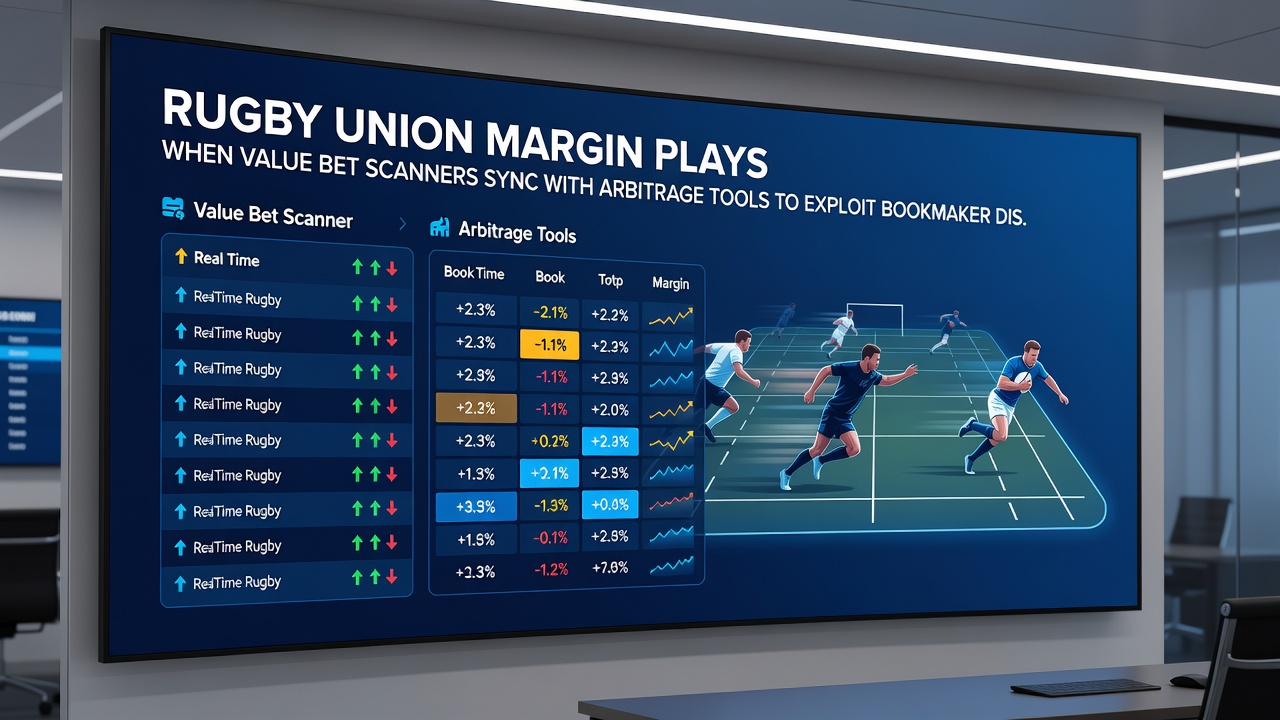
Modern platforms poll odds feeds every few seconds, convert each line into implied probabilities, then compare those figures against proprietary models that incorporate advanced metrics such as expected points added and territory-gained percentages. When a scanner registers a value margin exceeding a user-defined threshold, it simultaneously feeds the opposing line into an arbitrage engine that calculates stake ratios needed to lock in profit. Observers note that the process runs continuously because rugby schedules stretch across multiple time zones, with matches in New Zealand often priced while European books are still updating overnight.
Data from the International Centre for Sport Security shows that cross-border liquidity spikes during July and August, months when international windows bring together teams from both hemispheres and prompt rapid odds adjustments. In July 2026, several mid-week fixtures between northern and southern sides produced documented margin discrepancies exceeding four points on handicap lines within the first thirty minutes of market opening.
Practical Workflow Across Time Zones
Users typically configure alerts for specific margin thresholds, then allow the combined system to monitor both pre-match and in-play books. A scanner might identify an overpriced “under 2.5 tries” line at an Asian-facing operator while an arbitrage calculator simultaneously locates an opposing “over 3.5 tries” line at a South American book; stake allocation software then distributes capital proportionally. Because rugby matches last eighty minutes plus stoppage time, in-play scanners continue to recalculate remaining margins after each score, extending the window for hybrid value-arb entries.
Regulatory Landscape and Data Sources
Operators must comply with licensing conditions set by authorities such as the Gambling Regulatory Authority of Mauritius, which requires transparent margin reporting on all rugby markets. Industry reports from the Canadian Gaming Association indicate that licensed books operating in multiple jurisdictions maintain separate risk-management teams for each region, contributing to the very pricing inconsistencies that scanners exploit. Those structural differences persist even as global liquidity increases, because local regulatory caps on maximum stakes and payout percentages remain jurisdiction-specific.
Case Examples from Recent Seasons
One documented sequence occurred during a July 2026 Lions tour match in which a New Zealand-licensed book posted a +7.5 handicap at +110 while a UK-facing exchange simultaneously listed –6.5 at –105. The scanner flagged both lines within the same minute, the arbitrage engine produced a 2.8 percent locked return, and the combined position closed before kick-off. Similar patterns have appeared in Currie Cup and National Provincial Championship games when European books price southern fixtures with less granular data on domestic player rotations.
Conclusion
Rugby union margin plays therefore represent the intersection of scanner-driven value detection and arbitrage execution across geographically dispersed books. The method relies on continuous data feeds, jurisdictional pricing variances and the extended duration of rugby contests rather than any single predictive insight. As international schedules continue to interleave northern and southern competitions, the technical linkage between these tools remains the primary mechanism through which participants convert bookmaker discrepancies into structured returns.